

Wood pellets may look intact at the pellet mill outlet, yet the bagged product contains more broken pellets and fine wood particles after cooling, conveying and bagging. These small particles and powder are commonly called fines. Before changing equipment settings on the wood pellet production line, identify the first stage where the amount of fines increases noticeably. Do not assume that the pellet mill has failed to form the pellets properly, or limit the investigation to the pellet bagging machine.
TCPEL recommends checking pellet strength separately from damage caused by the cooling, conveying and bagging equipment. A pellet screening machine removes fines that have already formed, but cannot make weak pellets stronger. Wood pellets that contain few fines after screening may still break during subsequent conveying.
Compare Pellet Samples from Different Production Stages
While the wood pellet production line is operating steadily with the same raw material batch, collect representative pellet samples from the pellet cooler outlet, after pellet screening and after bagging. Account for the time pellets need to travel between sampling points. Use a consistent sampling procedure and screening method at every sampling point. Do not compare a sample containing the full mixture of pellets and fines from one stage with only the powder collected from the bottom of a bag at another stage.
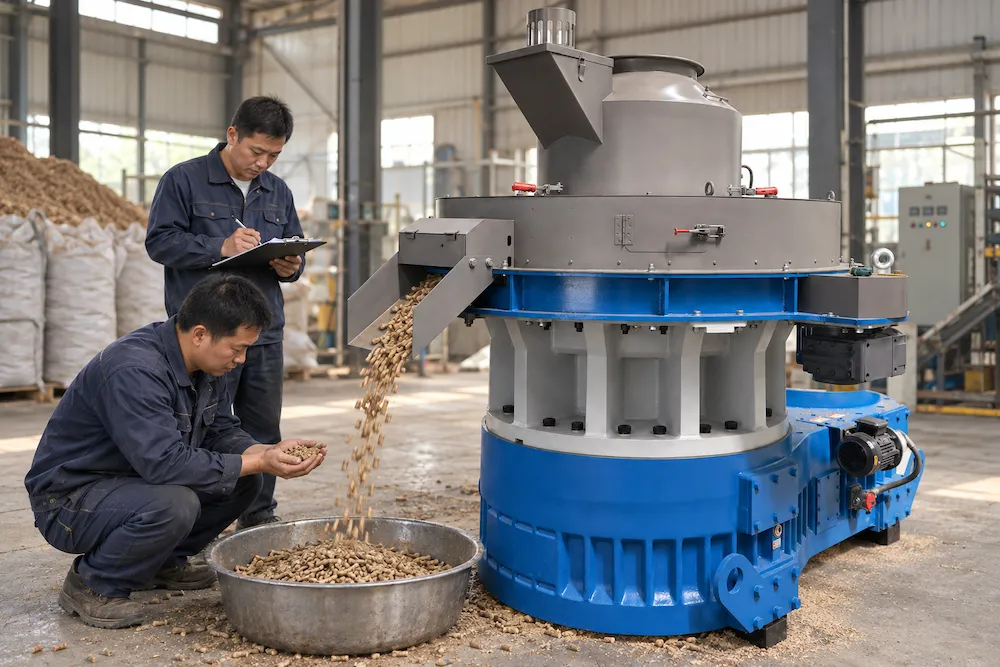
If samples from the pellet cooler outlet already contain many broken pellets, collect an additional reference sample directly from the pellet mill outlet. Cool the pellet mill reference sample using a consistent method before comparing it with the pellet cooler outlet sample. Do not judge pellet strength by comparing how freshly pressed hot pellets and cooled pellets feel in the hand. Pellet hardness describes how difficult an individual pellet is to crush; mechanical durability describes how well pellets resist breakage and wear during mechanical handling. A hard individual pellet does not prove that the whole pellet batch will withstand transport without breaking.
Collect pellet samples at the safe sampling points designated for the equipment. Before cleaning a machine, opening its covers or adjusting its components, stop that machine, isolate and lock out its energy sources, and safely release or restrain any stored energy. Never reach into running machinery on the wood pellet production line.
Trace the Cause to the Stage Where Fines Increase
Weak Pellets in the Cooled Pellet Mill Reference Sample
Sawdust batches can differ in wood species, bark content and the amount of wood shavings. Particle size distribution, meaning the proportion of sawdust in each particle size range, can also vary between batches. Changes in raw material properties can affect how sawdust forms into pellets in the same pellet mill. A pellet mill die and operating settings that worked with the previous sawdust batch may not suit the new batch. Unsuitable sawdust moisture content, or uneven mixing of wet and dry sawdust, can also make pellet quality inconsistent.
If excess fines appear after a raw material change, compare the composition, moisture content and particle size distribution of the previous and current raw material batches.
If the problem starts after replacing a pellet mill die or press rollers, or after pellet mill repairs, check the replacement part specifications, installation and wear. Avoid adding water to the sawdust, increasing the pellet mill feed rate and moving the press rollers closer to the pellet mill die at the same time. Changing several pelletizing conditions at once prevents you from identifying which adjustment improved pellet quality.
More Pellet Breakage After the Pellet Cooler
If the reference sample from the pellet mill remains largely intact after separate cooling, but pellets discharged by the enfriador de pellets contain more broken pieces, check how the pellet cooler is operating. Check the pellet cooler discharge rate, pellet bed depth and airflow distribution. Pellet bed depth is the thickness of the layer of pellets inside the pellet cooler. A running cooling fan does not prove that pellets throughout the pellet bed are receiving adequate cooling. An increase in pellet production rate may require different cooling conditions.

Inspect the pellet cooler for accumulated pellets and blocked air passages, and compare pellet discharge temperatures at different locations. Adjust the pellet cooler according to its operating requirements. Simply increasing the pellet cooler airflow may not improve cooling. Under certain conditions, including low cooling air inlet temperatures, rapid cooling can increase the risk of cracks in the wood pellets.
Few Fines After Screening but More Fines After Bagging
Excessive drop height, impacts against hard surfaces and repeated transfers can break or wear down wood pellets as they move from a conveyor into a pellet storage bin or pellet bagging machine. The gradual wearing away of pellet material is called attrition. At the first piece of equipment where fines increase, compare pellet samples taken immediately before and after that equipment. Inspect the pellet transfer chute and the point where the falling pellets land. Look for accumulated pellets and places where pellets are being squeezed or crushed.
If the connection between two pieces of pellet handling equipment is causing damage, have engineering personnel adjust the pellet drop path or the way the next piece of equipment receives the pellets. Changes to the pellet transfer arrangement should not create new blockage points. Pellets breaking at a transfer point may already have inadequate strength before reaching that point. Finding extra fines at a conveying point does not, by itself, rule out problems with the sawdust or the way the pellet mill forms the pellets.
High Fines Content After Pellet Screening
Inspect the pellet screening machine for blocked screen openings, a damaged screen surface or damaged seals. Check whether pellets and fines are bypassing the screen surface and entering the finished pellet outlet without being screened. Compare the fines content of pellet samples taken before and after the screening machine. Fines content is the proportion of a sample’s mass made up of fines. Comparing fines content before and after screening shows whether the pellet screening machine is separating fines effectively. A running pellet screening machine does not, by itself, prove that fines have been removed.
Good Retained Pellet Samples but Poor Pellet Quality on Delivery
A retained sample is a representative portion of a pellet batch kept at the factory for later comparison. If the retained sample is in good condition but pellets from the same batch arrive in damp bags, form clumps or become loose and crumbly, inspect the packaging for damage. Check whether the pellet shipment was exposed to rain or damp storage conditions. Wood pellets can lose strength when they absorb moisture. If the delivered pellets show no signs of moisture damage, check whether bags were thrown or dropped, or handled repeatedly during loading and unloading.
Why TCPEL Checks the Pellet Transfer Chute Before Replacing a Pellet Mill Die
At TCPEL, we compare pellet samples from the pellet cooler outlet, the pellet screening machine outlet and the transfer chute outlet immediately before the pellet bagging machine. Comparing pellet samples from these production stages helps us identify where broken pellets and fines first increase noticeably. We do not recommend replacing a pellet mill die simply because a bag contains a lot of fines.

We prioritize the pellet conveying equipment between the pellet screening machine and pellet bagging machine when all three findings occur together:
- Pellet samples from the pellet cooler outlet and pellet screening machine outlet are close in quality to those from a normal production batch.
- The mechanical durability of the pellet samples shows no noticeable decline when tested using the same method as the normal batch.
- The amount of fines increases sharply at the pellet transfer chute outlet.
Comparing pellet quality at several points along a wood pellet production line can narrow the investigation, but cannot completely rule out inadequate pellet strength.
During a pellet transfer chute inspection, we check whether falling pellets strike one area of a steel plate and whether the point receiving the pellets has shifted. We also look inside the pellet transfer chute for accumulated pellets and places where pellets are being squeezed. Once a clear pellet impact problem is identified, engineering personnel should adjust how the pellet transfer chute delivers pellets to the next piece of equipment. Keep the sawdust, pellet mill die, pellet production rate and pellet cooler settings unchanged while adjusting the pellet transfer arrangement. After the chute adjustment, collect pellet samples again at the original sampling locations and compare the results.
After a pellet transfer chute adjustment, we look for a sustained reduction in newly broken pellets and fines in both the chute outlet samples and the bagged pellet samples. Only when both sets of samples consistently improve do we have grounds to identify impact at the pellet transfer chute as the main cause of the extra fines. TCPEL first locates the stage where fines increase, then checks the diagnosis by making one adjustment at a time and comparing pellet samples afterward. Checking the cause in this way helps avoid replacing a pellet mill die or changing the sawdust moisture content before the cause is clear.
Judge the Result by the Final Bagged Pellets
After any adjustment to the wood pellet production process, recheck the final bagged pellets as well as the pellets leaving the pellet mill. Keep retained samples from each pellet batch and repeat pellet quality checks whenever the raw material, pellet production rate or pellet conveying route changes. Keep pellet packaging and storage conditions dry. Routine sampling, quality checks and dry storage make an increase in fines easier to trace than adjusting several machines at once after the problem appears.
If you still cannot identify where fines increase along the wood pellet production line, póngase en contacto con TCPEL. Please provide the model numbers of the equipment involved, details of raw material changes, comparisons of pellet samples from different production stages, and records of recent equipment or process adjustments. These details help TCPEL recommend corrective action for the specific cause of pellet breakage and fines.
 Español de México
  English
  Bahasa Indonesia
  العربية
  Français
  Русский
  Português do Brasil
  Italiano