
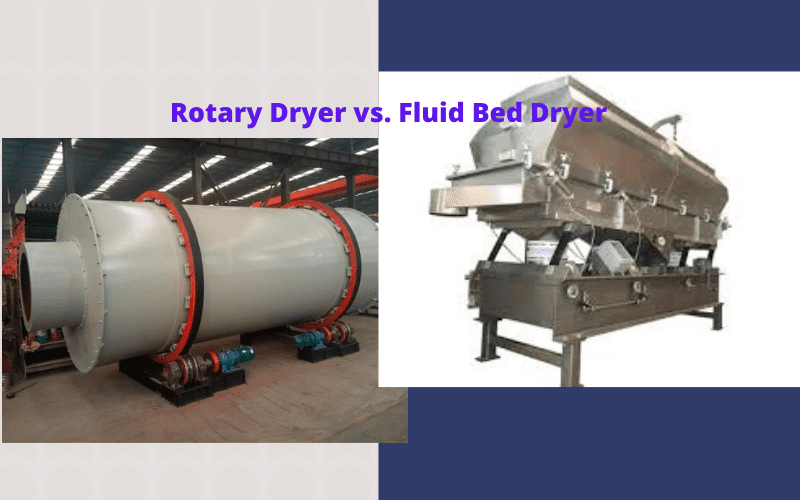
Essiccatore rotativo vs letto fluido: differenze chiave
Rotary dryers and fluid bed dryers are both used for industrial drying, but they are built for different material behavior, heat transfer methods and plant layouts. A rotary dryer is usually selected for continuous drying of bulk materials such as sawdust, wood chips, biomass, fertilizer and minerals. A fluid bed dryer is usually selected for more uniform powders or granules that can be lifted and dried by controlled airflow.
For pellet production and biomass handling, the main selection question is not only dryer price. Buyers should compare raw material size, initial moisture, target moisture, dust level, heat source, capacity, maintenance plan and downstream equipment before choosing the dryer type.
Quick Comparison Table
| Articolo | Rotary dryer | Fluid bed dryer |
|---|---|---|
| Drying method | Material tumbles through a rotating drum while hot air passes through or across the material | Hot air passes through a perforated bed and suspends uniform particles in a fluidized state |
| Best material fit | Sawdust, wood chips, biomass, fertilizer, minerals and bulk materials with variable size | Powders, granules and particles with more uniform size and good airflow behavior |
| Moisture handling | Suitable for many high-moisture bulk materials, depending on dryer size and heat source | Works best when material can fluidize evenly and does not stick or agglomerate heavily |
| Capacity range | Commonly used for continuous medium to high-capacity drying projects | Often used where controlled drying and uniform air contact are more important than heavy bulk handling |
| Footprint | Longer layout because of the drum, feeding, discharge and air system | Often more compact, but airflow and dust collection must be carefully designed |
| Maintenance focus | Drum, drive, seals, lifting flights, support rollers and dust collection | Air distribution plate, fan, filters, bed condition and dust handling |
| Typical TCPEL use | Biomass drying before pelletizing, fertilizer drying and bulk material drying lines | Used as a comparison option when material uniformity and process control require fluidization |
How a Rotary Dryer Works
A essiccatore rotante uses a rotating drum to move material through the drying chamber. Lifting flights inside the drum raise and drop the material so hot air can contact more surface area. The dryer can be designed for different heat sources, air direction, drum size and downstream dust collection.
This design is practical for many biomass and bulk material projects because the material does not need to behave like a perfect powder. Sawdust, wood chips, manure-based fertilizer, minerals and other irregular materials can often be dried when the feeding, residence time and air system are correctly matched.
How a Fluid Bed Dryer Works
A fluid bed dryer uses high-volume air to lift particles through a perforated bed. When material particles are uniform and can fluidize evenly, heat transfer can be fast and consistent. This is why fluid bed dryers are often used in chemical, pharmaceutical, food, powder and granule applications.
The limitation is material behavior. If the material is sticky, too wet, too fibrous, too coarse or too mixed in size, fluidization may become unstable. In that case, the dryer may need more pre-processing or a different drying method.
Material Fit and Moisture Control
Rotary dryers are often selected when the incoming material has variable particle size or higher moisture. In a biomass pellet line, a rotary dryer can be placed before the pellet mill to reduce sawdust or wood chip moisture to a suitable range for pelletizing.
Fluid bed dryers are more suitable when material flows evenly and does not form large clumps. They can be useful when the process needs controlled residence time, even air contact and careful final moisture control.
Capacity, Energy and Layout
Dryer capacity depends on initial moisture, target moisture, material density, heat source, airflow, residence time and feeding stability. A rotary dryer can be a good choice for continuous bulk drying where space is available for the drum, furnace or burner, cyclone, dust collector and conveyors.
A fluid bed dryer may be more compact in some layouts, but the air distribution system, fan power, filters and dust control must be designed carefully. For dusty material, air handling should be discussed before selecting the dryer type.
When to Choose a Rotary Dryer
- You need to dry sawdust, wood chips, biomass, fertilizer, minerals or other bulk materials.
- Your material has variable particle size, variable moisture or fibrous structure.
- You are planning a continuous drying section before a macchina per pellet di biomassa or linea di produzione di pellet.
- You need a complete system with feeding, heat source, drum dryer, cyclone, dust collector and discharge conveying.
When to Choose a Fluid Bed Dryer
- Your material is powder or granules with relatively uniform particle size.
- The material can fluidize evenly without heavy sticking or agglomeration.
- You need controlled drying for a process where even air contact is important.
- Your plant can support the required fan, air distribution, filtration and dust handling system.
Selection Checklist Before Quotation
| Information to confirm | Why it matters |
|---|---|
| Raw material name and particle size | Determines dryer type, feeding method and air handling |
| Initial moisture and target moisture | Determines heat load, drum size or airflow requirement |
| Required capacity | Determines dryer dimensions, fan, heat source and conveying equipment |
| Heat source | Affects operating cost, safety design and layout |
| Downstream process | Pelletizing, cooling, screening or storage may require different moisture control |
| Dust and exhaust requirements | Determines cyclone, dust collector and local compliance planning |
TCPEL Rotary Dryer Support
TCPEL supplies rotary dryer systems for biomass, fertilizer and bulk material drying projects. The dryer can be combined with feeding conveyor, heat source, cyclone, dust collector, discharge conveyor and downstream pelletizing equipment according to the confirmed project scope.
If you are comparing dryer types, TCPEL can first review your material, moisture and production target, then recommend whether a rotary dryer is suitable for your process.
Rotary Dryer vs Fluid Bed Dryer FAQ
What is the main difference between a rotary dryer and a fluid bed dryer?
A rotary dryer tumbles material through a rotating drum, while a fluid bed dryer lifts uniform particles with hot air through a perforated bed.
Which dryer is better for sawdust and biomass?
A rotary dryer is often more practical for sawdust, wood chips, biomass residues and materials with variable particle size or moisture.
When is a fluid bed dryer suitable?
A fluid bed dryer is suitable for more uniform powders, granules or heat-sensitive materials that need controlled drying and even air contact.
Which dryer is easier to run at high capacity?
Rotary dryers are commonly selected for continuous bulk drying and higher throughput, but the final choice depends on material, moisture and plant layout.
Do both dryers need dust collection?
Most industrial drying systems need proper air handling and dust collection. The design depends on material dust, airflow, temperature and local requirements.
What information should I send before choosing a rotary dryer?
Send raw material, initial moisture, target moisture, capacity, heat source, available space, downstream equipment and destination port.
Need help choosing an industrial dryer? Send raw material, initial moisture, target moisture, required capacity, heat source, voltage, layout limits and destination port. TCPEL can recommend whether a rotary dryer or another drying solution is more suitable for your project.
Parlare con un esperto
Parlare con un esperto
 Italiano
  English
  Español de México
  Bahasa Indonesia
  العربية
  Français
  Русский
  Português do Brasil