

A wood pellet mill may run normally on one batch of sawdust, then draw a consistently higher main motor current after a new batch is introduced. Pellet output may also fall, even though the pellet mill die and screw feeder speed have not changed. Main motor current means the current drawn by the motor that drives the pellet mill, not the separate feeder motor.
Start by comparing the previous and new sawdust batches and the actual weight of sawdust entering the pellet mill each minute. Do not assume the pellet mill die is damaged, and do not try to restore output by moving the press rollers progressively closer to the pellet mill die.
The checks in this article apply to flat die pellet machines и vertical ring die pellet machines during stable sawdust pellet production. Compare steady-state running current, which is the main motor current during normal continuous operation, rather than current measured at startup.
If overload protection has tripped, or the pellet mill develops unusual noise, a burning smell or abnormal heating, stop and inspect the equipment according to its operating procedures. Do not repeatedly reset the protection and force the pellet mill to restart. Before cleaning the pellet mill, opening its covers or adjusting its components, isolate and lock out the equipment’s energy sources.
The Same Screw Feeder Speed Does Not Mean the Same Sawdust Feed Rate
For a screw feeder without a weighing system that reports the actual feed rate, screw speed alone does not show how many kilograms of sawdust enter the pellet mill each minute. The weight of sawdust delivered per unit of time is the mass feed rate. The actual mass feed rate depends on sawdust bulk density and the screw feeder’s degree of fill.
Bulk density is the weight of loose sawdust per unit of bulk volume, including the spaces between particles. Degree of fill describes how much of the space inside the screw feeder is occupied by sawdust. A denser batch that flows more readily into the screw feeder may deliver more kilograms of sawdust per minute, even at the same screw speed.
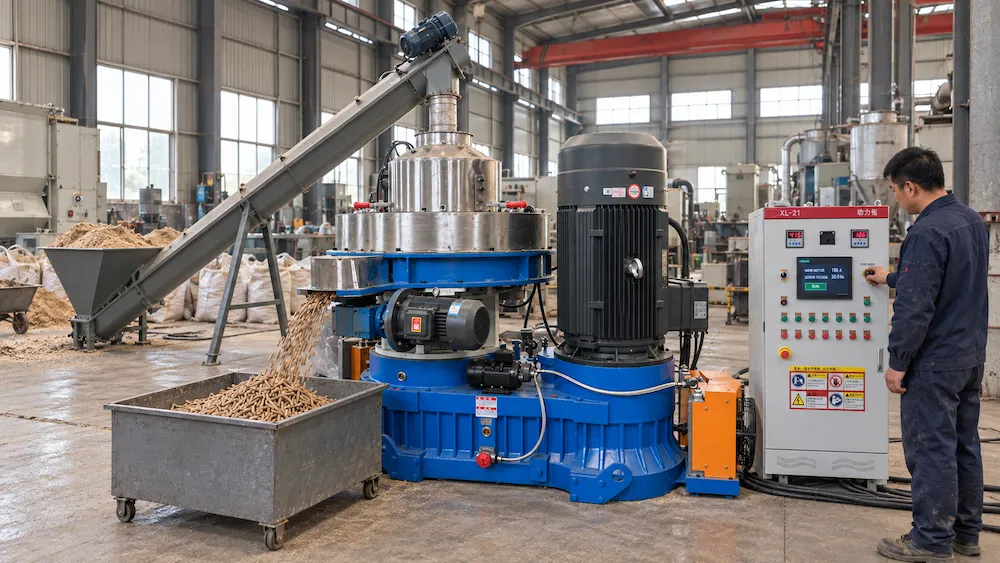
If the actual mass feed rate exceeds the pellet mill’s current processing capacity, sawdust may accumulate in the pelletizing chamber and increase the main motor load. Compare the actual weight of the previous and new sawdust batches delivered to the pellet mill over equal periods, using existing weighing records or a safe measurement method permitted for the equipment. The position of the feeder speed control knob is not a measurement of sawdust feed rate. Do not reach into the outlet of a running screw feeder to catch and weigh sawdust.
Check Whether the New Sawdust Suits the Existing Pellet Mill Settings
Sawdust from different wood species may contain different proportions of bark, wood shavings and long fibers. Differences in sawdust composition can change the resistance to compression and extrusion as material passes through the pellet mill die holes. A pellet mill die that worked well with the previous sawdust batch may not deliver the same pellet output at the same main motor load with the new sawdust batch. Research on wood pellet production also shows that wood species, moisture content and temperature affect the energy needed for compression and friction.
Measure the moisture content of the sawdust prepared to enter the pellet mill, rather than relying on a reading from one spot in the storage pile. Use the same moisture measurement method for the previous and new sawdust batches, and check for uneven moisture within each batch. If sawdust moisture content is unsuitable, use mixing, drying or moisture conditioning in the raw material preparation stage before the sawdust enters the pellet mill. High main motor current alone does not prove that the sawdust is too dry. Do not respond to high current by adding water directly into the pelletizing chamber.
Check whether the new sawdust batch contains more coarse wood shavings or long fibers. Changes in particle size distribution, meaning the proportions of material in different size ranges, can affect sawdust flow and compaction. Finer sawdust is not automatically better for pelletizing. Compare the results of sieving samples from the previous and new sawdust batches before deciding whether to adjust the grinding process. Comparing particle sizes before changing the grinding process helps avoid unnecessary grinding costs.
Why Lower Pellet Mill Main Motor Current Does Not Confirm the Cause
At TCPEL, we distinguish between two possibilities when main motor current rises after a sawdust batch change: the pellet mill is receiving more kilograms of sawdust per minute, or the same weight of sawdust is harder to compress and force through the pellet mill die. Reducing the sawdust feed rate can lower the main motor current in either situation. A lower main motor current after reducing the sawdust feed rate therefore does not, by itself, prove that the screw feeder is faulty or that the new sawdust is suitable.
If weighing records show that the new sawdust enters the pellet mill at a higher mass feed rate than the previous batch at the same screw feeder speed, TCPEL first determines a safe screw feeder setting for the new sawdust. If the actual mass feed rate has not increased, we continue comparing sawdust moisture content, composition and particle size distribution. We do not immediately recommend replacing the pellet mill die. When adjusting sawdust feed rate or raw material preparation, keep other pellet production conditions as consistent as possible. Then compare the pellet mill main motor current during stable operation, actual pellet output and cooled pellet quality before and after the adjustment.
If correcting a confirmed difference in sawdust feed rate or raw material properties brings both main motor current and pellet output back to normal on a sustained basis, that difference can be identified as the main factor affecting operation. If main motor current remains high, or unusual noise or abnormal heating develops, continue investigating mechanical and electrical causes. Do not attribute every operating problem to the sawdust batch change.
Check Pellet Mill Components and the Electrical System
Once sawdust moisture content, composition and particle size distribution are close to those of a normal production batch, stop the pellet mill and isolate and lock out its energy sources before inspecting the pelletizing components. Check the pellet mill for blocked die holes, sawdust buildup in the pelletizing chamber, seized press rollers, lubrication problems and foreign material. If the pellet mill die or press rollers were replaced, or maintenance was carried out around the time of the sawdust batch change, review the pellet mill parts and installation records as well.
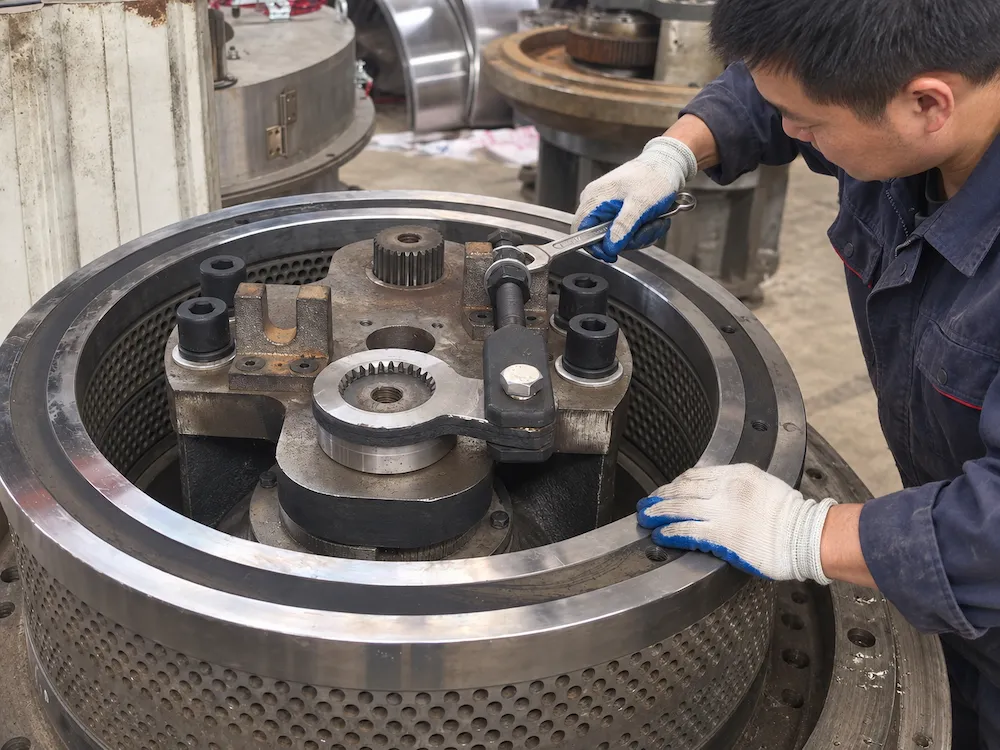
Adjustment procedures differ between flat die pellet machines and vertical ring die pellet machines. Do not copy the die–roller clearance from another pellet mill; the gap between the die working surface and press rollers must suit the specific machine model.
Problems with the electrical supply can also change the pellet mill’s main motor current. A qualified electrician should check the pellet mill motor supply voltage, current in all three phases, motor circuit wiring and drive alarm records. Operators should not open the pellet mill’s energized electrical cabinet to investigate high main motor current.
If the pellet mill display shows the input current of a variable frequency drive (VFD), do not treat that reading as the pellet mill motor current on the VFD output side. Do not increase the pellet mill overload protection settings just to keep the pellet mill running.
After a sawdust batch change, the goal is to produce pellets that consistently meet quality requirements while keeping the pellet mill within its permitted load. A lower pellet mill main motor current reading alone does not confirm that production has returned to normal. Keep raw material samples, screw feeder settings and operating records from normal production batches for comparison when the sawdust batch next changes.
If the cause of high main motor current remains unclear, связаться с TCPEL with the pellet mill model, records from before and after the sawdust batch change, and details of recent adjustments.
 Русский
  English
  Español de México
  Bahasa Indonesia
  العربية
  Français
  Português do Brasil
  Italiano