Configurable Pellet Production Lines for Wood and Biomass Fuel
What Is Included in a Pellet Production Line?

TCPEL provides configurable pellet production line solutions for wood, sawdust, wood residues, and confirmed agricultural biomass fuel materials. Each project begins with the raw material form, initial moisture, required finished-pellet output, operating hours, power supply, site conditions, and required supply scope. Pelletizing is the core stage; chipping, crushing, drying, cooling, screening, conveying, dust collection, and packing are selected only when the project requires them. Production-line capacity means the nominal finished-pellet output of the configured complete line at the discharge point after pelletizing and the required cooling or screening process under the confirmed project conditions. TCPEL can provide equipment selection, process design, main and auxiliary equipment, electrical and control systems, installation guidance, commissioning support, and operator training as agreed in the quotation or contract. Share your project inputs to receive a matched line configuration.
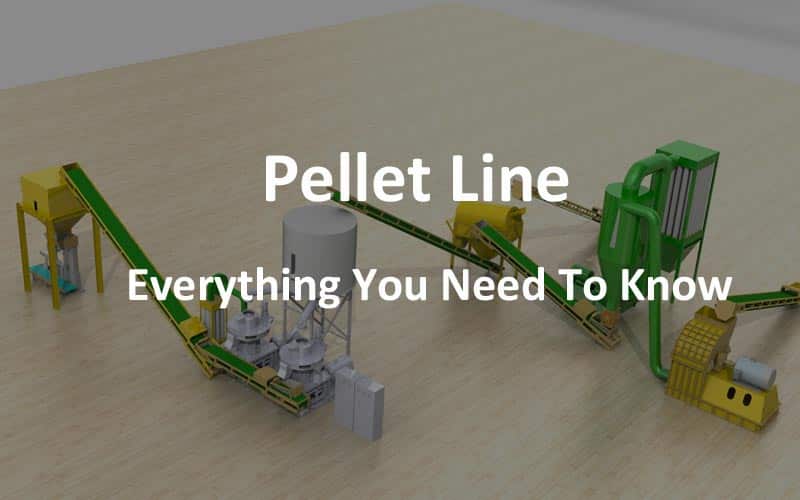
A complete pellet line is configured from confirmed project inputs. Pelletizing is the core stage; preparation, downstream handling, equipment supply and engineering services are added only when the selected process and agreed project scope require them.
Configurable Pellet Production Lines for Wood and Biomass Fuel
Quick Answer: What Is Included in a Pellet Production Line?
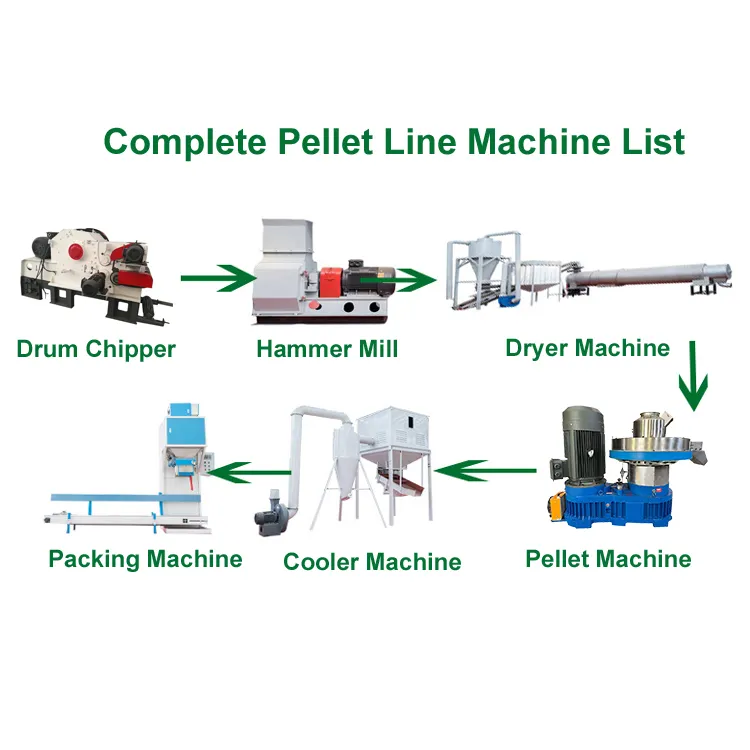
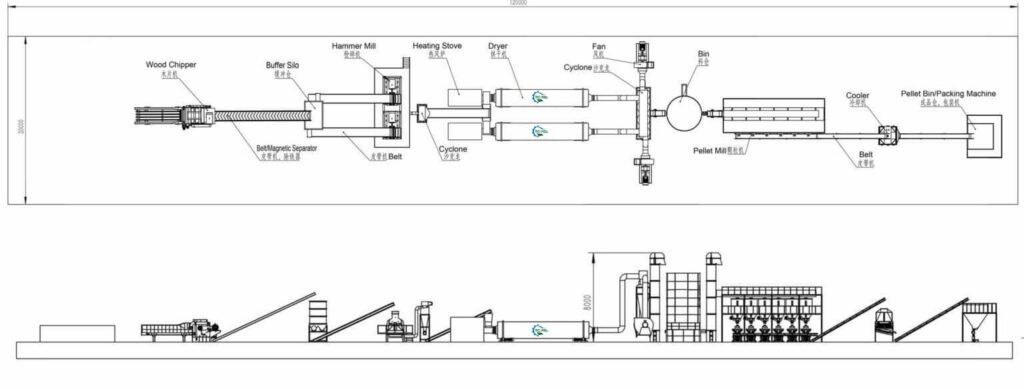
A pellet production line includes the equipment and services required by the confirmed project—not one universal fixed machine list. Pelletizing is the core stage. Depending on the raw material form, size, moisture, target output, final pellet requirement, and operating plan, the configuration may add chipping, crushing or hammer milling, drying, conveying, cooling, screening, dust collection, fines return, and packing. Electrical and control systems are configured for the selected equipment. TCPEL’s agreed supply scope may also include process design, preliminary layout, technical drawings, installation guidance, commissioning support, and operator training. Civil works, buildings, local utilities, permits, and site infrastructure are not automatically included.
Wood and Agricultural Biomass Fuel Project Routes
Wood Pellet Production Line Route
Wood, sawdust and wood-residue projects start from the actual incoming form. Logs, branches or oversized material may require primary size reduction, while prepared sawdust may bypass that stage. Compare wood pellet machines when a standalone pelletizing route is needed.
Agricultural Biomass Fuel Route
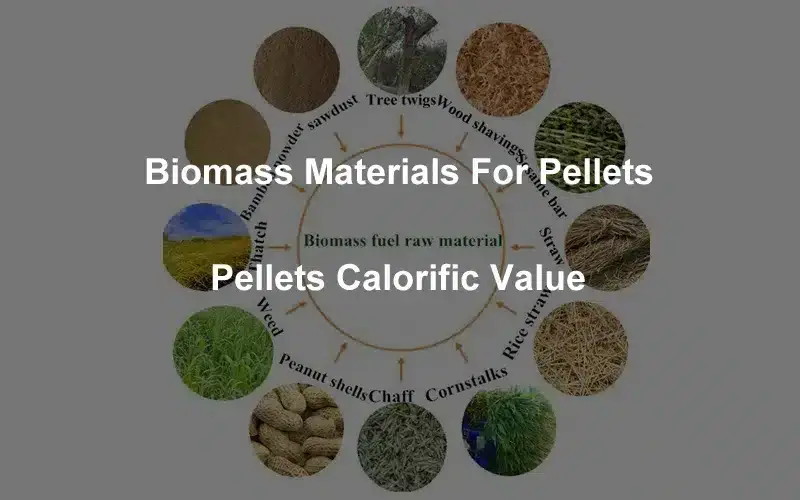
Confirmed project contexts include straw, grass, corn straw or stalk, and ground nut or peanut shell. Preparation and equipment selection depend on the actual material. Compare biomass pellet machines for the standalone machine route.
Pelletizing Equipment Routes
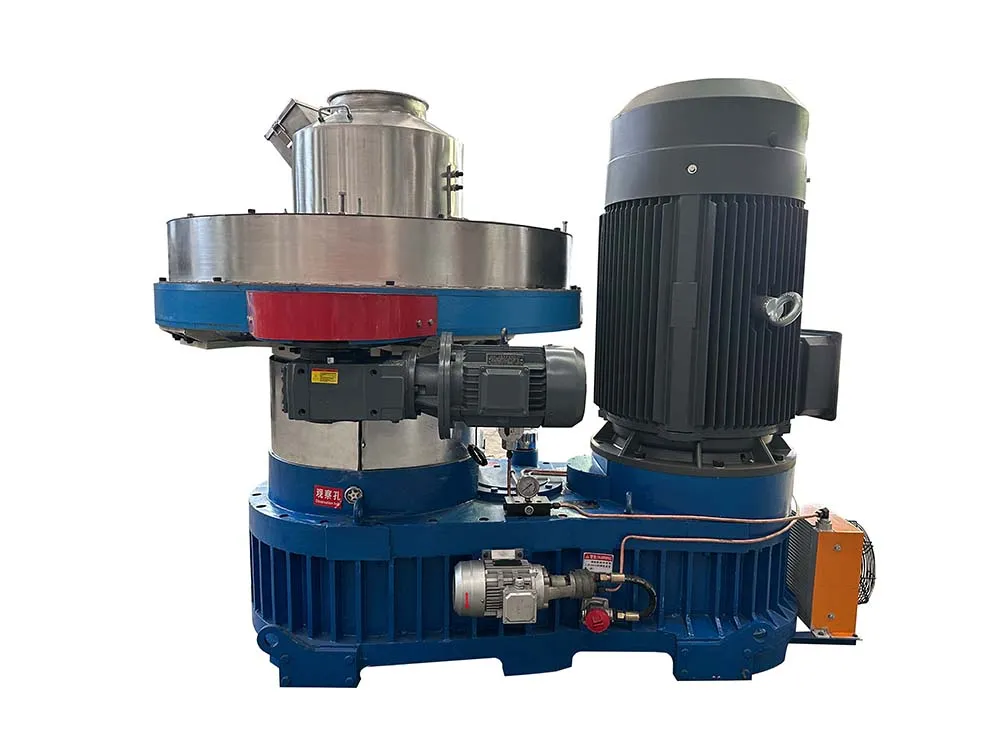
The pelletizing stage is selected from the confirmed material, required finished-pellet output, operating schedule and project scope. Use the flat die pellet machines или industrial vertical ring die pellet mills pages for family-specific selection and model details. Page 279 does not combine their model tables or output values into one generic line range.
What Pellet Production Line Capacity Means
Canonical metric: FULL_LINE_NOMINAL_FINISHED_PELLET_OUTPUT. Production-line capacity means the nominal finished pellet output of the configured complete line under the confirmed project conditions, measured at the finished-pellet discharge stage after pelletizing and the required downstream cooling or screening process.
Final line capacity is determined from the raw material, moisture condition, required finished-pellet output, operating schedule, selected process configuration and equipment matching. TCPEL does not publish one generic production-line capacity range for every project. Pellet mill output, dryer dry-material output, dryer water evaporation, chipper output, crusher or hammer-mill output, cooler throughput and packing rate are separate process-stage metrics; none of them alone equals full-line capacity.
How a Pellet Production Line Is Configured
Each process stage must be selected and matched so upstream or downstream equipment does not become the limiting bottleneck of the designed line. The rule is qualitative: there is no universal matching margin or reserve percentage for every project.

TCPEL Manufacturing and Project Support
Engineering Support
TCPEL engineers support process selection, equipment matching, preliminary layout and technical communication for the confirmed project scope.
Контроль качества
Selected equipment is checked through the applicable manufacturing and pre-delivery quality-control process before shipment.
Configurable Equipment Scope
Main equipment, conveying, auxiliaries and controls are selected from the actual raw material, process and project requirements.
Project Communication
The commercial and engineering teams use the confirmed project inputs to clarify the proposed equipment and service scope.
Commissioning Support
Installation guidance, commissioning support and operator training can be included when stated in the quotation or contract.
Contract-Bounded Supply
The quotation and contract identify the supplied equipment, engineering services, responsibilities and exclusions for the project.
Turnkey Equipment and Engineering Scope
What TCPEL Can Include
- Process design and equipment selection
- Main production equipment
- Required conveying and auxiliary equipment
- Electrical and control systems
- Preliminary layout and technical drawings
- Installation guidance and agreed on-site support
- Commissioning support and operator training
Project and Contract Boundary
The final scope is confirmed in the quotation or contract. Full EPC, civil works, buildings, local utilities, permits, environmental approvals, site infrastructure, customer-side construction and all installation labor are not automatically included.
Standalone Pellet Machine or Complete Line?
Choose a standalone pellet machine when the raw material already meets the selected pelletizing route and the required preparation and downstream equipment are available. Choose a complete pellet production line when the project needs coordinated preparation, pelletizing, downstream treatment, handling, control or engineering support.
What Information Is Needed for Line Selection?
- Тип сырья
- Raw Material Form
- Initial Moisture
- Required Finished Pellet Output
- Target Final Product or Pellet
- Operating Hours
- Power Supply
- Standalone Machine or Complete Line Scope
- Project Location
Detailed engineering fields such as final layout, civil interfaces, installed power, dust-control detail and acceptance conditions are confirmed later for the specific project.
Conditional Pellet Production Process Flow
| Process Stage | Classification | When It Applies |
|---|---|---|
| Pelletizing | CORE | The core conversion stage; the flat die or vertical ring die route is selected for the project. |
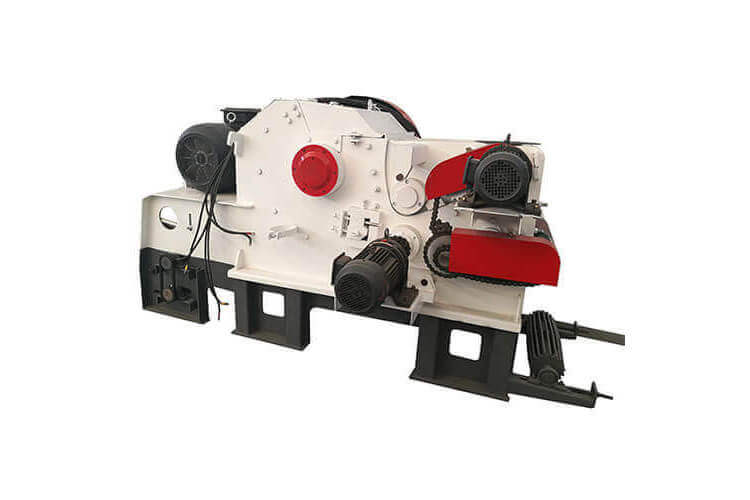
| Chipping | CONDITIONAL | Used for logs, branches, slabs, offcuts or other oversized wood that needs primary size reduction. |
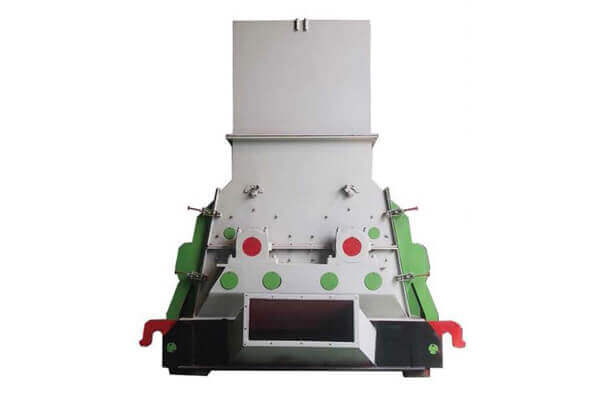
| Crushing / Hammer Milling | CONDITIONAL | Used when the incoming particle condition is not suitable for the selected downstream process. |
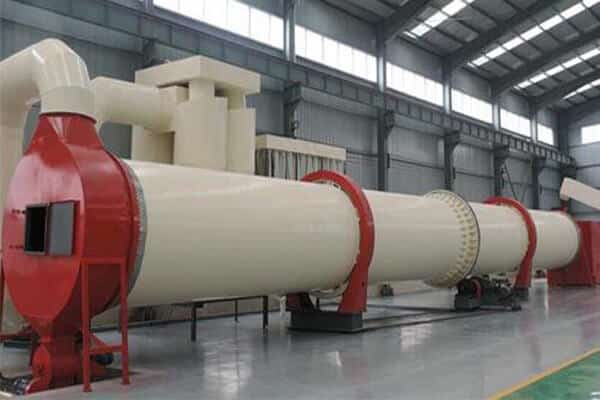
| Сушка | CONDITIONAL | Selected from the actual initial moisture, required process condition, material flow and evaporation load. |
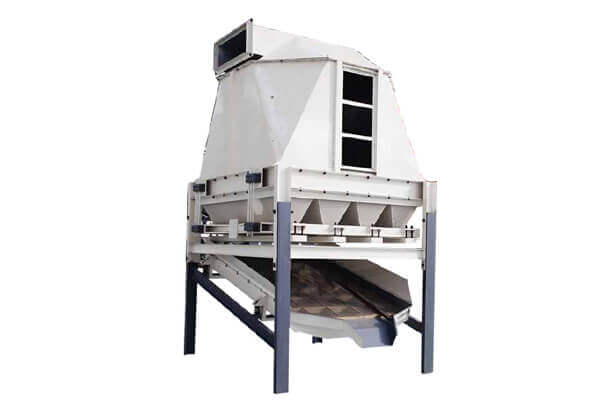
| Cooling | CONDITIONAL | Added when the selected pelletizing route and finished-product handling require it. |
| Screening | CONDITIONAL | Added when fines separation or finished-pellet preparation is required. |
| Fines Return | PROJECT-SPECIFIC | Included only when the validated process design includes recirculation. |
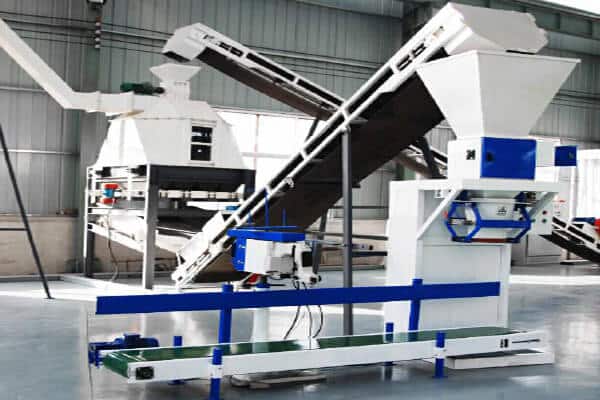
| Packing | OPTIONAL / PROJECT-SPECIFIC | Selected from the required package format, storage plan or bulk-handling route. |
| Dust Collection | PROJECT-SPECIFIC | Defined from the selected equipment, transfer points, layout and local requirements. |
| Electrical / Control | CONFIGURABLE | Matched to the supplied equipment, power supply, automation level and interface scope. |
No fixed equipment list applies to every wood or agricultural-biomass fuel project. The final process flow and equipment list are confirmed from the project inputs.
Pellet Line Equipment and System Routing
drum chippers for oversized wood
Conditional primary size reduction for logs, branches, slabs, offcuts or other oversized wood forms.
hammer mills for particle preparation
Conditional particle preparation when the incoming material is not ready for the selected pelletizing route.
rotary dryers for moisture adjustment
Conditional drying selected from the actual material, moisture condition, flow and evaporation requirement.
Pelletizing Equipment
The flat die or vertical ring die family is selected for the confirmed material, output target, operating schedule and project scope.
Conditional downstream equipment when the selected pelletizing and finished-product handling route requires cooling.
Optional, project-specific finished-product handling selected from the confirmed package or bulk-handling scope.
Pellet Production Line FAQs
There is no universal fixed equipment list. Pelletizing is the core stage; chipping, crushing, drying, conveying, cooling, screening, fines return, dust collection and packing are selected only when the project requires them.
Start with the raw material type and form, initial moisture, required finished-pellet output, target pellet, operating hours, power supply, project scope and location. TCPEL then selects and matches the required process stages.
It is the nominal finished-pellet output of the configured complete line under the confirmed project conditions, measured at the finished-pellet discharge stage after pelletizing and the required downstream cooling or screening process. No single generic range is approved for every project.
No. Pellet mill output is a pelletizing-stage metric. Dryer, chipper, crusher, cooler and packing metrics are also stage-specific; none alone is the finished-pellet output of the complete configured line.
No. Drying depends on the actual feedstock moisture, selected process, pelletizing requirement, material flow and evaporation load for the project.
Chipping is conditional. Logs, branches, slabs, offcuts or other oversized wood may require primary size reduction, while prepared sawdust may not require a chipper.
Wood and confirmed agricultural biomass fuel projects can use the same commercial project owner, but they do not automatically use the same process or equipment. Material suitability and the final configuration are confirmed for each project.
The agreed scope can include process design, equipment selection, main and auxiliary equipment, conveying, controls, preliminary layout and drawings, installation guidance, commissioning support and operator training. The quotation or contract defines the final inclusions.
Full EPC, civil works, buildings, local utilities, permits, site infrastructure, customer-side construction and all installation labor are not automatically included unless the quotation or contract specifically states otherwise.
Choose a standalone machine when the material is prepared and the required upstream and downstream equipment already exists. Choose a complete line when multiple stages, interfaces, controls or engineering services must be coordinated.
Planning Resources for Pellet Production Projects
Wood Pellet Preparation Guide
Pellet Project Business Planning
Equipment Procurement Planning
Pellet Machine Troubleshooting