
Calculate dryer water evaporation from a dry-solids mass balance, rather than from the moisture-percentage difference alone. Start with the required dried-material output and the inlet and outlet moisture contents, all on a consistent wet basis. The balance first identifies the dry solids leaving the dryer, then calculates the wet material needed to supply those solids. The difference between wet feed and dried output is the theoretical water evaporation rate. The calculated value is the required theoretical water removal, not a tested machine capability. For example, producing 2,000 kg/h of dried material at 15% moisture from feed at 50% moisture requires 3,400 kg/h of wet feed and removal of 1,400 kg/h of water. This basic calculation assumes that dry solids are conserved. It establishes a material-flow requirement; equipment capacity, thermal duty, fuel consumption and the final dryer configuration require a separate project review.

Information Required
Collect the following information before calculating the drying requirement:
- Raw material: identify the biomass, sawdust, wood residue or other material to be evaluated.
- Inlet moisture: use a representative measurement of the material entering the dryer.
- Target outlet moisture: state the required condition of the dried material.
- Required dried-material output: specify the mass leaving the dryer per hour, including its remaining water.
- Moisture basis: confirm that both moisture values are on a wet basis.
- Planned operating hours: distinguish a running-hour output target from a daily production target.
- Available heat source: provide this for later equipment and thermal-system selection; it is not an input to the mass-balance equations below.
If a production target is stated per day, establish the planned effective operating hours before expressing it in kg/h. Do not assume that scheduled hours and effective production hours are identical.
Moisture Basis: Wet Basis vs Dry Basis
Wet-basis moisture is the mass of water divided by the total mass of the material, including that water. A sample at 50% wet-basis moisture therefore contains equal masses of water and dry solids.
Dry-basis moisture instead compares the water mass with the dry-solids mass. The two bases use different denominators and are not interchangeable. Confirm the basis shown by the moisture test method or laboratory report before using a value.
Every moisture value in the formulas and examples below is on a wet basis. Convert percentages to decimal fractions before substituting them: 50% = 0.50 and 15% = 0.15. Dried material output includes the residual water at the specified outlet moisture. It is not the dry-solids flow rate.
Water Evaporation Formula
- D
- Required dried-material output, kg/h; includes the remaining water at outlet moisture Mo.
- S
- Dry-solids flow rate, kg/h.
- Mi
- Inlet moisture fraction on a wet basis, dimensionless.
- Mo
- Outlet moisture fraction on a wet basis, dimensionless.
- W
- Required wet material feed rate, kg/h.
- E
- Required theoretical water evaporation rate, kg/h.
The basic calculation assumes steady-state operation with no material accumulation, no dry-solids loss and only water being removed. Dry solids are conserved, so the dry solids entering with W must equal the dry solids leaving with D. Loss of volatile components other than water must not be counted as water evaporation; if such losses occur, this water-only balance must be revised.
Dry solids in the dried output
S = D × (1 − Mo)
Wet material feed rate
W = S ÷ (1 − Mi)
W = D × (1 − Mo) ÷ (1 − Mi)
Water evaporation rate
E = W − D
Equivalent direct evaporation formula
E = D × (Mi − Mo) ÷ (1 − Mi)
Dry-solids and water balance check
At steady state, conservation of dry solids gives:
W × (1 − Mi) = D × (1 − Mo) = S
Solving this identity for W gives the wet-feed equations above. An independent water balance gives:
E = W × Mi − D × Mo
The inlet water flow is W × Mi and the outlet water flow is D × Mo. Because the inlet and outlet dry-solids flows are equal, this water balance also reduces to E = W − D under the stated assumptions.
For drying, use D > 0 and 0 ≤ Mo < Mi < 1. If Mi equals Mo, this ideal balance gives zero water evaporation. Mi = 1 makes the denominator zero, so these equations are undefined and must not be used. If the target moisture is higher than the inlet moisture, or an input is outside these limits, review the inputs and process requirement before applying a drying calculation.
Step-by-Step Worked Example
Assume a required dried-material output of 2,000 kg/h (2 t/h), inlet moisture of 50% wet basis and target outlet moisture of 15% wet basis.
The 15% outlet moisture is used only for this example; it is not a universal optimum or a recommendation for every material or application.
Step 1 — Calculate the dry solids
2,000 × (1 − 0.15) = 1,700 kg/h dry solids
Step 2 — Calculate the wet feed
1,700 ÷ (1 − 0.50) = 3,400 kg/h wet material
Step 3 — Calculate water evaporation
3,400 − 2,000 = 1,400 kg/h water evaporation
As a check, the wet feed contains 1,700 kg/h of water. The dried output contains 2,000 × 0.15 = 300 kg/h of water. Removing 1,400 kg/h leaves that 300 kg/h in the product while the 1,700 kg/h of dry solids remain unchanged.
This is a theoretical mass-balance example. It does not by itself confirm dryer model, heat input, fuel consumption or guaranteed project capacity.
Quick Reference Examples
Each row uses the same wet-basis equations and its own stated output target. These are calculated material flows, not tested machine ratings.
| Dried output D | Wet-basis moisture Mi → Mo | Wet feed W | Water evaporation E |
|---|---|---|---|
| 1,000 kg/h | 50% → 15% | 1,700 kg/h | 700 kg/h |
| 2,000 kg/h | 50% → 15% | 3,400 kg/h | 1,400 kg/h |
| 2,000 kg/h | 50% → 10% | 3,600 kg/h | 1,600 kg/h |
Holding the dried-output target constant while changing outlet moisture also changes the dry-solids flow required in that output. The three rows should not be interpreted as one unchanged feed stream operated at different settings.
What the Calculation Does Not Determine
Water evaporation is a mass flow, expressed here in kg/h. Thermal duty is a rate of heat transfer, commonly expressed in kW; it requires an energy balance and operating information beyond these equations. Fuel consumption also depends on the fuel and the complete thermal system.
The mass balance alone does not determine:
- Required heat duty or burner capacity
- Hot-air temperature or material residence time
- Fuel use or real operating efficiency
- Fan size or dust-collection size
- The final dryer model or its guaranteed equipment capacity
Equipment capacity is a machine rating under stated conditions and must identify whether it refers to wet feed, dried output or water evaporation. Read the published rating with its material, moisture conditions and supply scope. An evaporation requirement cannot be substituted directly for a finished-material output rating.
Factors That Change Actual Dryer Performance
The calculated water flow is one input to a drying-system review. Actual operation also depends on the raw material type, particle size, bulk density, moisture variation and feed uniformity. Heat-source stability, ambient conditions, airflow, dryer design, heat losses and actual operating control affect how the system performs.
Real projects may have dust or fines loss, material leakage, startup and shutdown variation, moisture measurement error, non-uniform feed and variable material composition. If dry material is lost, the basic assumption of equal inlet and outlet dry-solids flow no longer describes the complete system. Account for the actual loss streams and measurement boundaries before setting a project feed requirement.
Use representative moisture measurements and identify where each flow is measured. A brief steady observation should not be treated as proof of an entire shift’s average production.
Common Calculation Mistakes
- Treating dried output as wet feed. D is the material leaving the dryer; W is the wetter material entering it.
- Subtracting moisture percentages without conserving dry solids. The inlet and outlet percentages apply to different total material masses.
- Mixing wet-basis and dry-basis moisture. Confirm a common basis before calculation.
- Confusing evaporation with finished-material output. E is removed water, not product flow.
- Using a theoretical result as guaranteed equipment capacity. The balance does not establish the dryer’s heat transfer, air handling or operating capability.
How TCPEL Uses This Calculation for Dryer Selection
TCPEL needs project information before confirming a dryer and its supply scope. The required wet feed, dried output and theoretical water evaporation help define the material-flow requirement to be reviewed. They must be considered alongside the material characteristics, heat source, site conditions, operating schedule and equipment interfaces.
Provide the moisture basis and measurements with the enquiry, and identify any known feed or material losses. TCPEL can then review the relevant equipment configuration and the further information needed for a project quotation. The mass balance alone does not select a machine or establish a performance commitment.
This calculation is a planning tool. It does not provide operating setpoints, burner adjustments or electrical instructions, and it does not replace the selected machine’s operating and safety instructions.
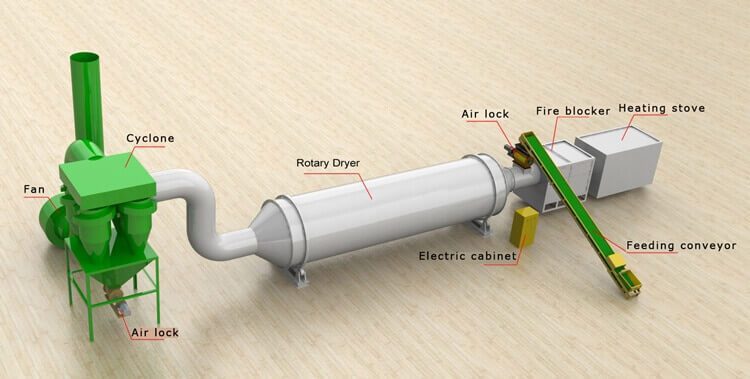
Related TCPEL Equipment
- TCPEL rotary dryers for biomass, sawdust and wood — review the existing equipment page and the project conditions to confirm before selection.
- TCPEL pellet production lines — consider how drying connects with material preparation, pelletizing and downstream equipment.
Related Knowledge
Return to Biomass Drying knowledge for the existing drying-route comparison and rotary-dryer heat-loss guides.
Sources: FAO guidance on moisture measurement explains wet-basis and dry-basis definitions. Purdue Extension’s discussion of drying and handling losses distinguishes water removal from dry-matter loss. These agricultural references do not establish TCPEL equipment ratings or a target moisture for biomass.
Request a Dryer Recommendation
Send TCPEL the information below so the drying requirement and relevant equipment scope can be reviewed:
- Raw material and representative material details
- Initial moisture and required final moisture, with the measurement basis
- Wet feed rate, if known
- Required dried-material output
- Daily operating hours
- Available heat source
- Power supply
- Destination country
- Standalone dryer or complete production-line requirement
Include the assumptions behind any calculated evaporation rate and identify unknown inputs.