
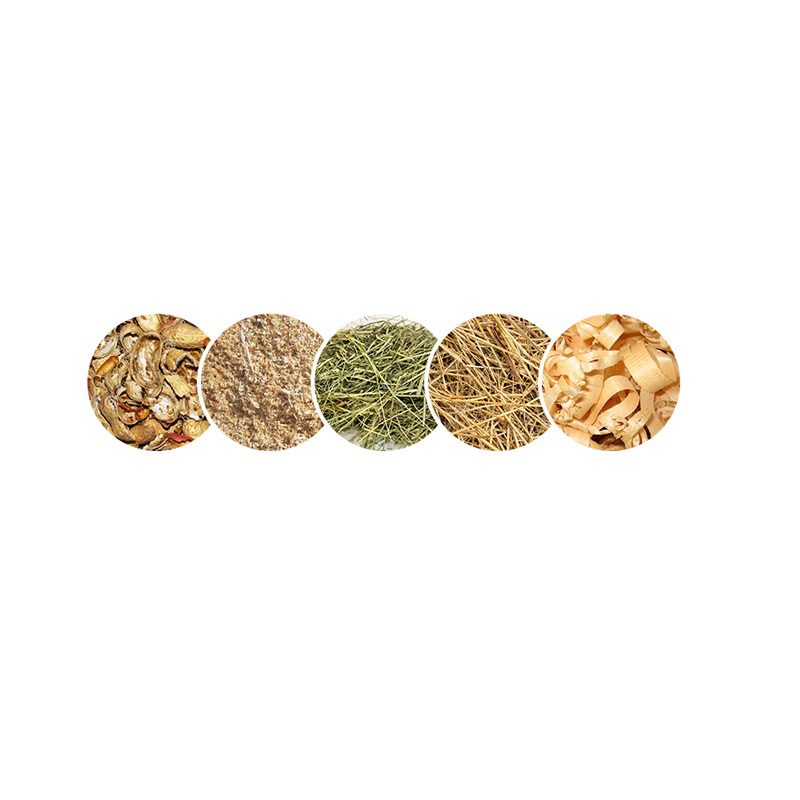
Materials Used for Pellet Production: Biomass, Feed and Waste
Pellet production materials can include wood waste, sawdust, straw, rice husk, grass, animal feed ingredients, manure and other agricultural residues. The suitable pellet machine depends on the material type, moisture, particle size, final pellet use and required capacity.
For stable production, raw material preparation is as important as the pellet machine itself. Some materials need crushing, drying or mixing before pelletizing. Others may need a different die, compression ratio or complete line configuration.
Quick Material Selection Table
| Material group | Common examples | Typical pellet use | Preparation before pelletizing | Related equipment |
|---|---|---|---|---|
| Wood waste | Sawdust, wood chips, shavings, furniture factory residues | Biomass fuel pellets | Crushing and drying are often required, depending on particle size and moisture | Biomass pellet machine, rotary dryer |
| Agricultural residues | Rice husk, straw, corn stalk, bagasse, palm fiber | Biomass fuel pellets or mixed biomass pellets | Size reduction, drying and material testing may be needed | Pellet making machines, dryer, crusher |
| Animal feed ingredients | Corn, soybean meal, bran, grass powder, feed additives | Poultry, cattle, sheep and livestock feed pellets | Crushing and formula mixing are important for uniform feed pellets | Feed pellet machine, crusher, mixer |
| Grass and forage | Alfalfa, hay, grass powder, forage material | Feed pellets or biomass pellets, depending on formula and use | Drying, grinding and mixing depend on moisture and final pellet use | Flat die pellet machine, feed pellet machine |
| Manure and fertilizer material | Composted manure, organic fertilizer powder, mixed fertilizer material | Organic fertilizer pellets | Moisture control, composting condition and screening should be checked | Pellet machine, dryer, cooler, screener |
| Mixed raw materials | Wood plus crop residues, feed formula blends, biomass mixtures | Depends on formula and target market | Testing is recommended because mixed materials behave differently in the die | Complete pellet production line |
Wood Waste and Sawdust
Sawdust and wood chips are common raw materials for biomass fuel pellets. Clean sawdust with controlled moisture is easier to process than mixed wood waste. Oversized chips should be crushed before pelletizing, and high-moisture material usually needs drying.
If the material contains bark, sand, metal or mixed species, output and die life may change. For commercial production, confirm ash content, moisture and particle size before choosing a biomass pellet machine.
Rice Husk, Straw and Crop Residues
Agricultural residues can be used for biomass pellets, but each material behaves differently. Rice husk, straw, corn stalk, bagasse and palm fiber may have different fiber structure, ash content and bulk density. Some materials need drying; some need finer crushing or mixing with other biomass.
For these materials, a small material test is often more reliable than selecting equipment only by name.
Animal Feed Ingredients
Feed pellets are made from formulas, not single fuel materials. A typical feed formula may include corn, soybean meal, bran, grass powder, minerals and other ingredients. The goal is uniform nutrition, suitable pellet diameter and stable hardness for animal intake.
For feed projects, choose a feed pellet machine according to animal type, formula, required capacity, pellet diameter and working hours. Crusher and mixer selection is usually part of the project.
Grass, Hay and Alfalfa
Grass, hay and alfalfa can be used for animal feed pellets or biomass pellets depending on the final use. Moisture and fiber length should be controlled before pelletizing. If the material is too wet or too long, feeding stability and pellet quality may be affected.
Small farm projects may use a flat die pellet machine, while larger feed projects should be evaluated by formula, capacity and continuous operating hours.
Manure and Organic Fertilizer Material
Manure and organic fertilizer materials need careful moisture and preparation control. The material is usually composted, crushed, mixed and screened before pelletizing. Dryer, cooler and screener selection depends on the fertilizer process and final pellet requirement.
Do not treat manure pellets the same as wood fuel pellets or animal feed pellets. The material behavior, drying requirement and end use are different.
Raw Material Requirements Before Pelletizing
| Requirement | Why it matters | What to check |
|---|---|---|
| Moisture | Too much or too little moisture can reduce output and pellet quality | Initial moisture, target moisture and whether a dryer is needed |
| Particle size | Oversized particles can block feeding or reduce pellet density | Crusher screen size and material consistency |
| Cleanliness | Sand, stones and metal can damage die and roller parts | Screening, magnetic separation and raw material storage |
| Bulk density | Low-density material affects feeding stability and line capacity | Feeding method and buffer storage design |
| Final pellet use | Fuel, feed and fertilizer pellets require different machine configuration | Pellet diameter, hardness, formula and packing requirement |
How to Choose Equipment by Material
- For wood waste and biomass fuel pellets, start with material moisture, particle size and required capacity.
- For animal feed pellets, start with formula, animal type, pellet diameter and mixing requirement.
- For manure or fertilizer pellets, confirm composting condition, moisture, screening and cooling requirements.
- For mixed materials, arrange a test or confirm machine configuration before ordering.
- For complete projects, match crusher, dryer, mixer, pellet machine, cooler, screener and packing machine as one system.
Pellet Production Material FAQ
What materials can be used for pellet production?
Common materials include sawdust, wood chips, straw, rice husk, grass, feed ingredients, manure, organic fertilizer material and other agricultural residues.
What is the best material for wood pellet production?
Clean sawdust or properly crushed wood chips are common choices for wood pellets, but moisture, particle size and ash content must be controlled.
Can fresh wood chips be made into pellets directly?
Usually not. Fresh wood chips often need crushing and drying before pelletizing because moisture and particle size strongly affect pellet quality.
What materials are used for animal feed pellets?
Animal feed pellets are usually made from a mixed formula such as corn, soybean meal, bran, grass powder, minerals and other feed ingredients.
Do all pellet materials need a dryer?
No. A dryer is needed when moisture is above the suitable range. Biomass materials often need drying, while some feed formulas may not.
What information should I send before choosing pellet equipment?
Send raw material, moisture, particle size, target pellet use, required capacity, pellet diameter, voltage and whether you need a single machine or complete line.
Need help testing your pellet raw material? Send raw material photos, moisture, particle size, target pellet use, capacity, pellet diameter, voltage and destination port. TCPEL can recommend a suitable machine or complete line configuration.
Talk to An Expert
Talk to An Expert